

Design service / Pitch Deck Design

Pitch Decks Built to Close the Room.

Story, design and content from one team.

A consumer-tech founder called us six days before her Series B partner meeting. Forty-two slides. The problem statement was on slide eleven. She had booked 18 first meetings that quarter and not one had come back.

We rebuilt it in eight working days. Her next partner meeting opened a term sheet. We have run the order that way ever since: story first, slides later.

Art-director led / Two-week first draft

A founder pitching to two investors in a quiet meeting room, a laptop deck open on the table beside a printed leave-behind. Studio work / Series B partner meeting

The math you face

Three minutes,
forty-four seconds.

That is what the average investor gives your deck on the first pass. The figure comes from Dropbox DocSend’s analysis of more than a million sessions. Storydoc’s 2026 set locates the real gate at slide three: 82% of investors who clear slide three finish the deck, and 31% are gone inside the first ten seconds.

Sales decks are no easier. Forrester puts the average B2B purchase at 13 internal stakeholders plus 9 outside participants. The deck is often the only artifact a buying committee shares internally, so we build for the version that travels.

Past clients have included HiSense, Camper, Age20 and Shiseido. Operating from Hong Kong under Beyond Border Group.

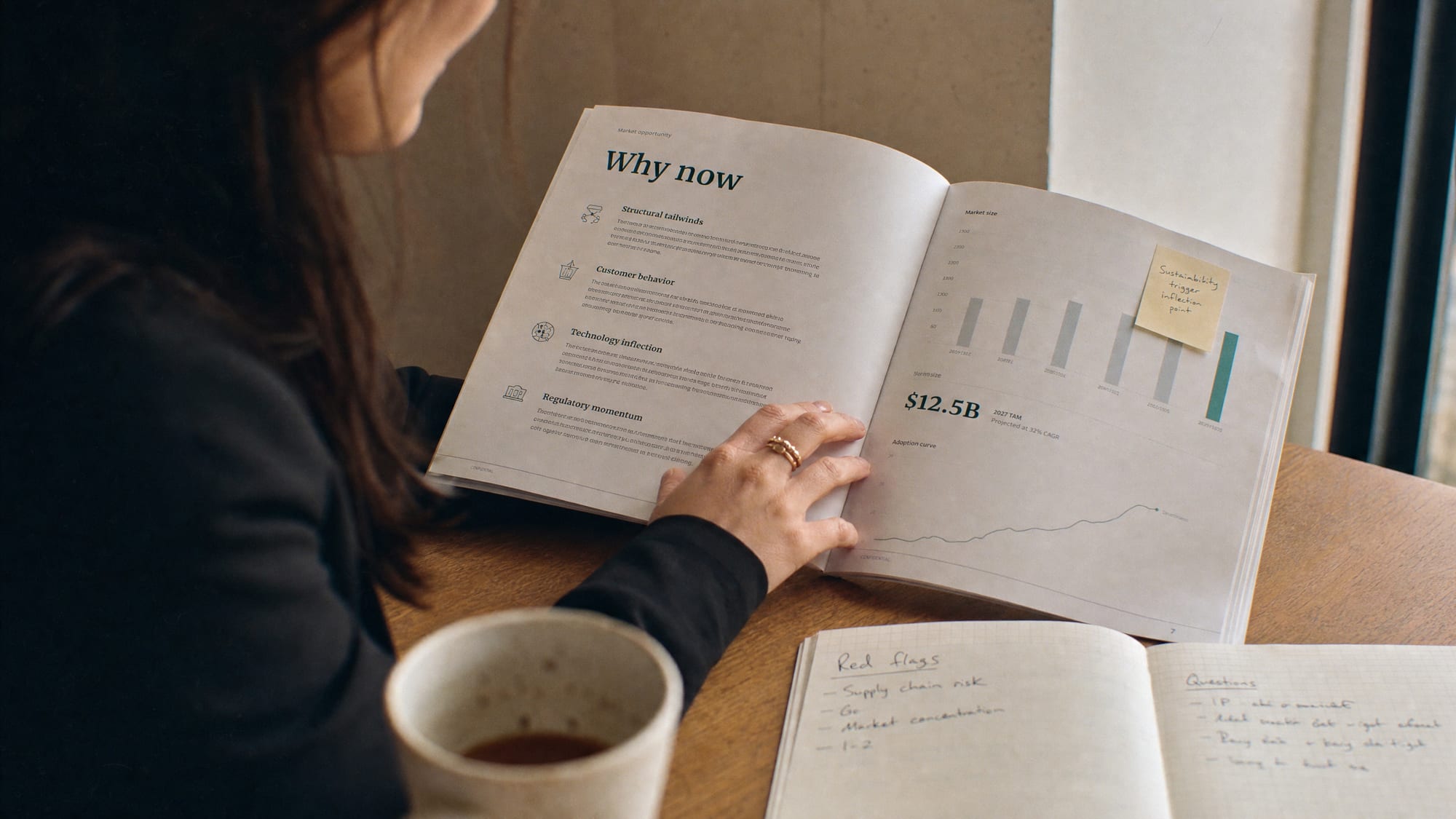
An investor at a desk reviewing a printed pitch deck, coffee cup beside it, half-frame on the slide and half on her face.
The three-minute first pass

Averages across about 60 engagements over the last two years, not single-project highs. First-round approval, second-meeting conversion on rebuilt decks, and the median brief-to-investor- ready turnaround.

0% First-round approval Across ~60 engagements
1.4x Second-meeting rate On rebuilt investor decks
0 days Median turnaround Brief to investor-ready

The work, defined

One service. Every
pitch context that matters.

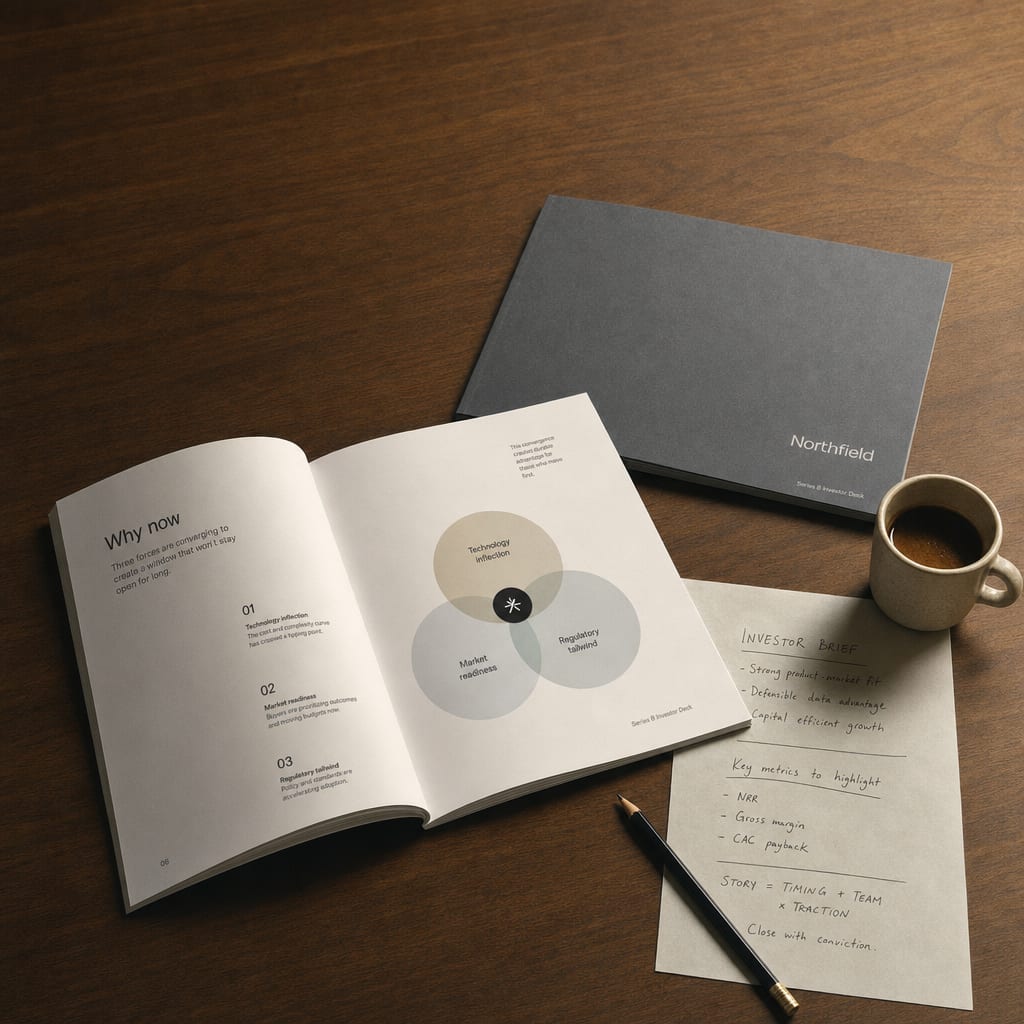
A printed Series B investor deck open at the "Why now" spread on a warm worktable beside a brief sheet and a pencil.
Investor

Coverage

Decks built for the partner meeting.

Pre-seed through Series C and later. Cold-email versions, full-meeting versions, diligence-grade appendices.

Cold-email versions under 10 slides for the inbox. Full-meeting versions at 12 to 14 for the room. Deep-dive variants with appendices for the partner who took your meeting and now has to defend you to the rest of the firm. We build the variants as one system because most growth-stage founders end up maintaining three or four versions of the same deck, and rebuilding each one from scratch is what burns the time.

Story first, slides later. The first three days go to why now, why this team and why this problem, in language a generalist partner can repeat from memory to colleagues who never met you. The 30% of decks that turn into a meeting tend to get passed around the firm before that meeting happens, so the deck has to make sense without you in the room.

In scope

  • Pre-seed to Series C
  • Cold-email versions
  • Full-meeting decks
  • Diligence appendices
  • Why-now framing
  • Team narrative
  • Traction charts
  • Partner-pass-around
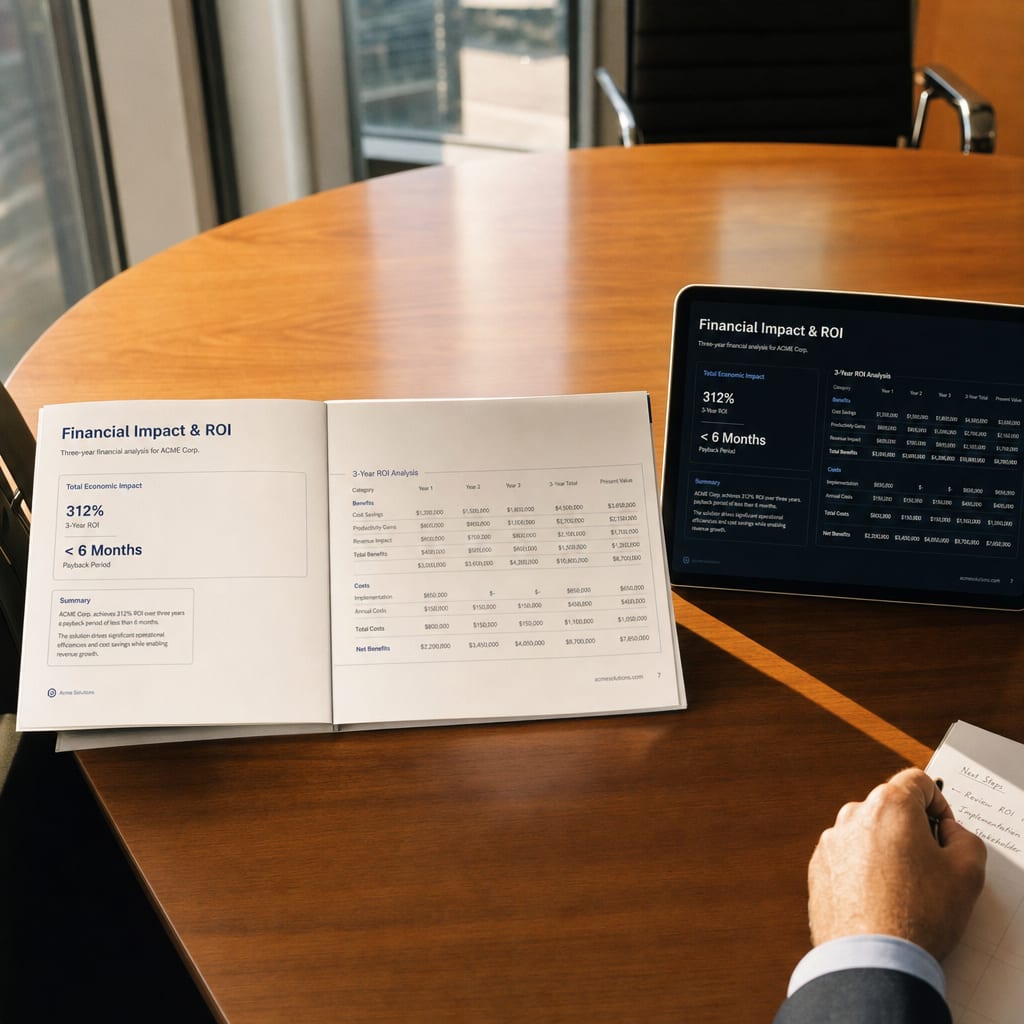
A printed enterprise sales deck open at an ROI math spread on a long conference table, beside a tablet showing the same slide.
Sales · Enterprise · RFP

Coverage

Decks built for the committee.

The deck is the artifact a buying committee shares internally. We build for the version that travels.

Sales decks at eighteen to thirty slides depending on cycle length, built for the rep in the room rather than the founder telling the origin story. The job is to give the champion inside the buyer's organization what they need to sell the deal to twelve other people you will never meet. ROI math, a competitive matrix, customer proof, implementation timeline, and pricing logic where it helps.

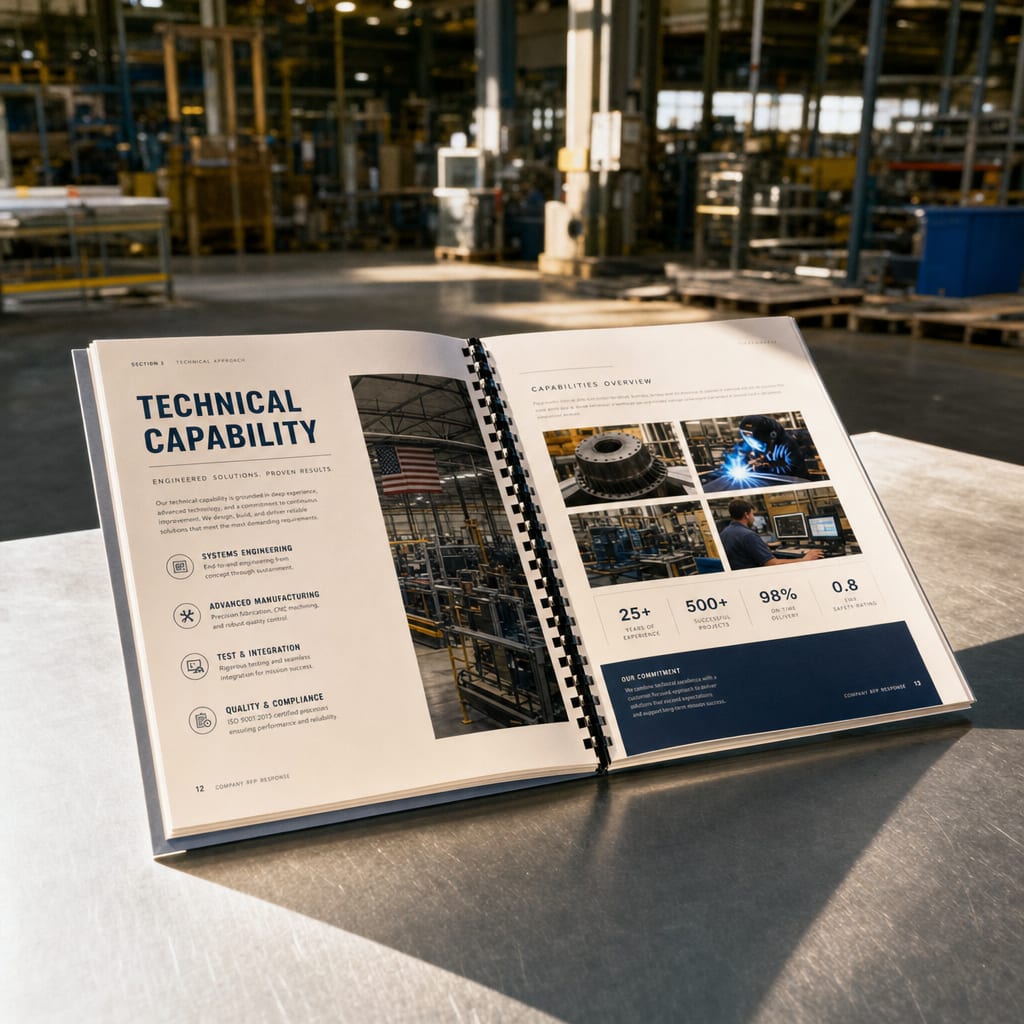
Enterprise and RFP decks where Loopio's 2026 data has teams averaging 39 hours on each response. Most of those hours go into restructuring content that already exists somewhere in the company. We do that work so the document survives past page three. M&A and corp-dev decks for sophisticated audiences with zero tolerance for fluff. Board, internal, and regional expansion decks for readers who already know the business: less polish, more density.

In scope

  • B2B sales decks
  • Enterprise pursuits
  • RFP responses
  • ROI math
  • Competitive matrix
  • M&A memos
  • Board updates
  • Regional expansion

Contact sheet

Selected proofs.

Pitch-deck artifacts and specimens, authored in the studio. Brands are anonymised; the engagements are real.

Open laptop on a quiet desk showing a Veridon investor deck title slide with a single chart and warm window light.
Veridon Series B investor deck
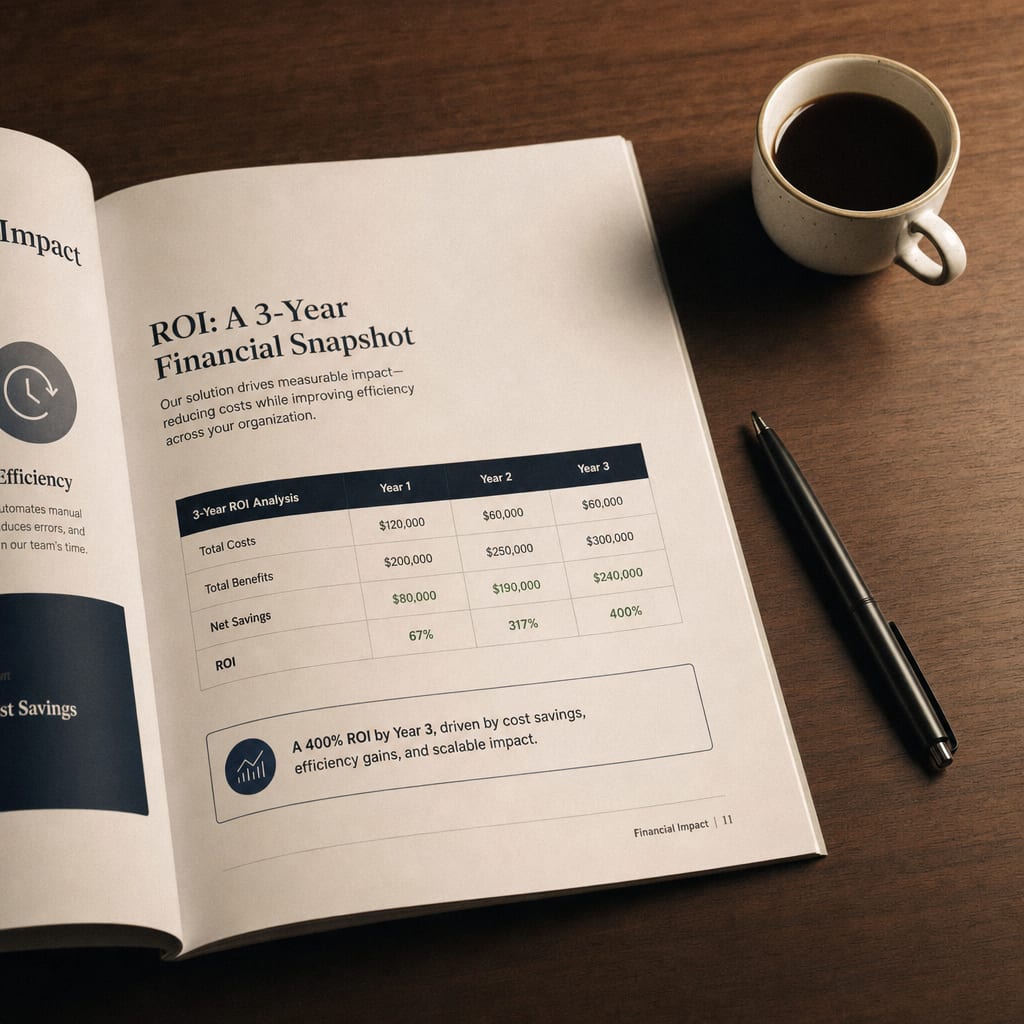
A printed Marlow sales deck open at the ROI math spread, on a worktable beside a pen and a coffee cup.
Marlow B2B SaaS sales deck
A Pellune retail-buyer pitch deck on a marble counter beside a sample beauty product, daylight through a tall window.
Pellune Retail-buyer pitch deck
A bound Ostran RFP response booklet open at a technical capability spread, on a metal worktable in a daylit warehouse.
Ostran OEM RFP response
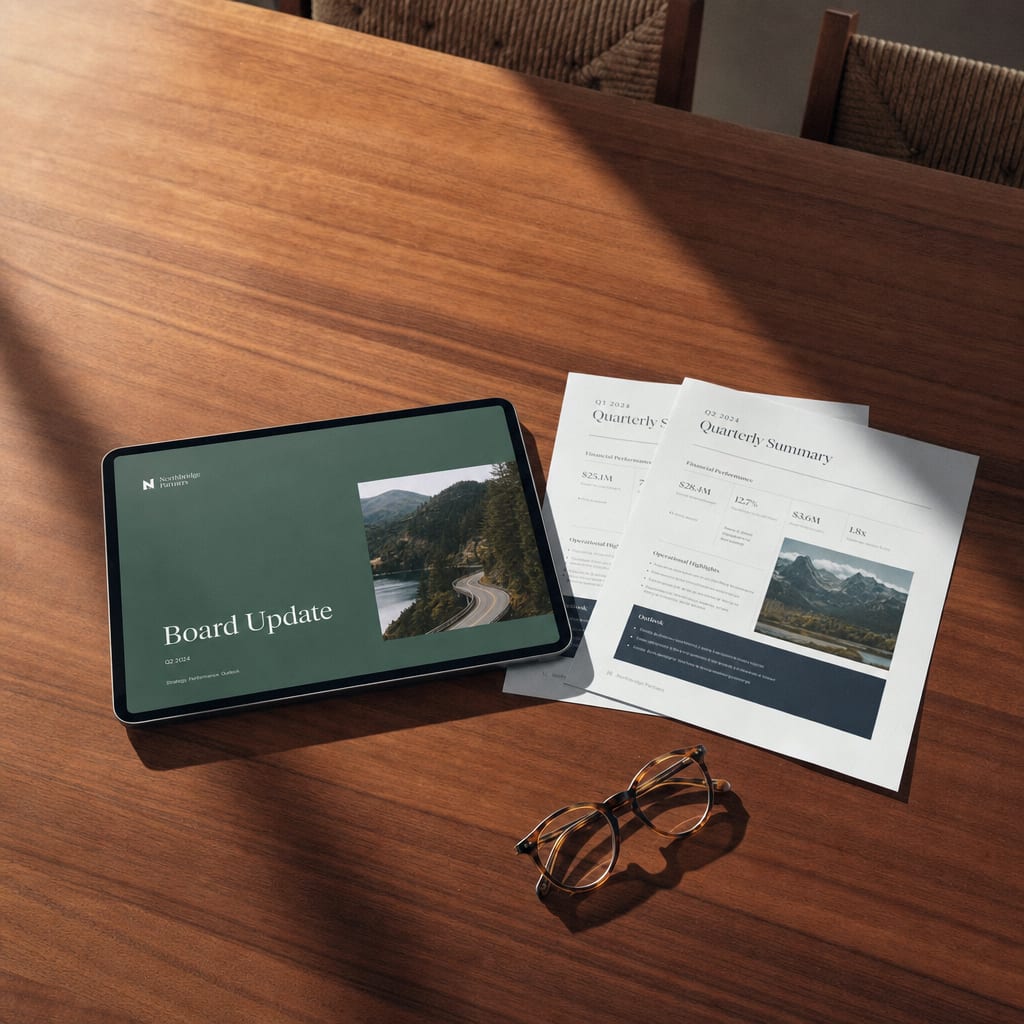
A Halver board-update deck on a tablet on a long conference table, two hardcopy summaries fanned beside it.
Halver Series C board deck
A Niven hospitality expansion memo open at a market-map spread, on a wood desk in a soft-lit hotel office.
Niven Hospitality expansion memo
An art director at a long studio table working through a printed slide outline, a second screen behind showing a Figma deck file.
Two hands annotating a printed pitch-deck slide with a red pencil, a colour chip book at the edge of the frame.
8 days Median brief to investor-ready

The craft

AI made the slides cheap.
The story is where it is still won.

Any founder with a credit card can spin up a deck in Gamma in forty minutes. The output looks fine. It also looks like every other deck the partner read this morning.

The patterns give themselves away inside a few slides. Stock photos lifted from the first page of Unsplash. Six bullets on a slide that should hold one idea. TAM numbers pulled from a research report the founder cannot defend if you ask one follow-up. Section headers that read like template fill-ins. Five Gamma layouts on rotation across every deck in the inbox this week.

  • Figma + Keynote
  • D3 + Recharts
  • Brand-trained models
  • Storydoc & custom web

We work the order backwards. The first three days go to story, before a designer touches a slide. Why now. Why this team. Why this problem, in language a generalist partner can repeat from memory. That work sets the slide order, the headlines, and what gets cut. About a third of slides usually do not survive the pass.

If your deck is strong and you just want a polish, we will quote it. But we charge for the story work whether you need it or not.

Our process

Five steps. Two weeks.
Three rounds.

The story is built before any layout exists. By the time a slide is designed, it already knows the room it is walking into and the partner it has to outlast.

First two steps are where it is won or lost. The rest is execution.

A founder on a discovery call at a quiet desk, an open notebook and a printed brief sheet beside the laptop in warm window light.
Where it is won

Brief and discovery.

A 60-minute call. Audience, story spine, slide list, the partner or buyer profile, the meeting you are walking into.

A studio wall covered in printed slide headline cards in a vertical column, a strategist pointing at one with a pencil.
Where it is won

Story architecture. The step that matters most.

Headlines written for every slide before a single layout exists. The document the partner remembers. About a third of the slides usually do not survive this pass.

A grid of two pitch-deck visual directions printed and pinned across a fabric board, each with three hero slides.
The rest is execution

Design exploration in parallel.

Two visual directions worked through with three to five hero slides each. The client picks one from a short PDF, not from a live tool, and we lock the system.

A designer at a workstation with two monitors, a Figma file with the pitch deck on one and a linked Excel chart on the other.
The rest is execution

Full build with real data.

All slides, real charts pulled from the source data, speaker notes where helpful, dark-mode variant for live presentation, light variant for the leave-behind.

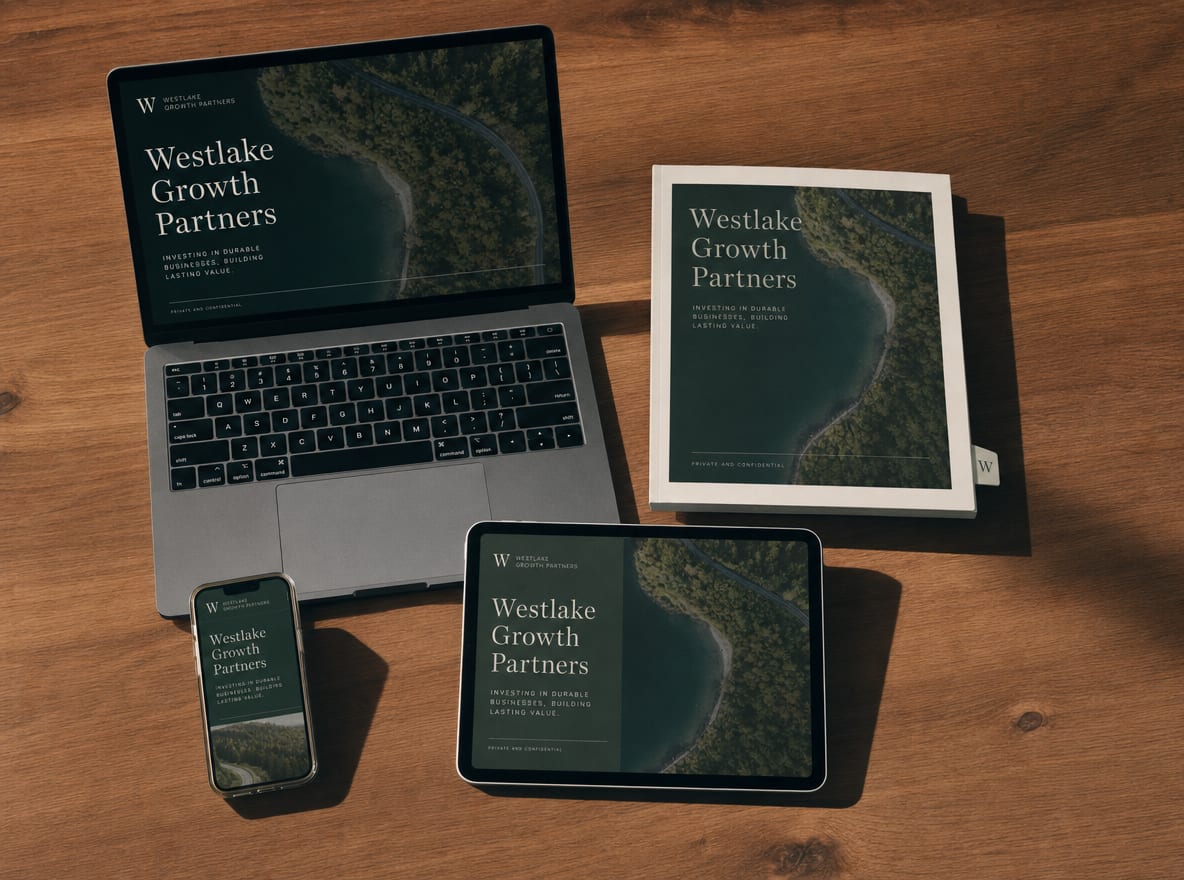
A flat-lay of four pitch-deck variants on a worktable: a laptop, a printed booklet, a tablet and a phone, each showing the same hero slide in different formats.
The rest is execution

Polish, variants and handover.

Three rounds of revisions in the quote, most projects close inside two. Aspect-ratio swaps, market variants, PowerPoint export for procurement, scrollytelling web version when the deck has to live as a link.

The new math

How AI changes
the math.

A founder lands six days before a Series B partner meeting. Forty-two slides, the problem statement on slide eleven. The same brief, run two ways.

The agency workflow Six weeks
Story Two weeks Design Three weeks Revisions One week

Agency timeline on a standard 15-to-20-slide investor deck: two weeks of story workshops, three weeks of design, a week of revisions. Partner time billed at full rate, three rounds, junior teams running the work. The deck you needed Tuesday lands the following month.

Our workflow Two weeks
Brief to investor-ready Two weeks

Story locks in the first three days. Two visual directions worked through with three to five hero slides each. Full build with real data, dark-mode variant, speaker notes, PowerPoint export. Express track compresses it to one week when the meeting is next Tuesday: same team, same process.

Two weeks from brief to final files on a standard 15-to-20-slide investor or sales deck. One week on the express track, which uses the same team and same process, just compressed (we will tell you on the first call if your timeline is realistic). Three weeks for enterprise or RFP work over 30 slides. Faster when we are extending an existing system you have already invested in.

We do not publish a rate card because scope ranges too widely. A single investor deck for a Series A founder is a different engagement than a quarterly board deck system for a growth-stage company with regional variants. We sit in the middle of the market: more than a freelancer on Upwork, less than a Tier-1 agency. We quote firm after the first call once the scope is clear, and we will tell you in the same call whether what you need is something we should be doing or something a template could handle.

Both. Project-based for one-off decks. Monthly retainer for ongoing volume, which is what most growth-stage companies move to once they are running multiple decks, regional variants, and sales enablement in parallel.

Both, and we recommend you let us. The story is where most decks fail. Treating writing and design as separate engagements is how you end up with slides that look polished and say nothing. We rewrite headlines, body copy, captions and speaker notes alongside the design. If you have a copywriter you would rather use, we work to their text.

Three. Most projects close inside two. Beyond round three we quote hourly, but it is rare on pitch work because the story is locked in week one.

Art directors with agency backgrounds (Publicis, Ogilvy, WPP, and similar) lead the story and design. AI specialists handle the production volume on custom imagery, chart variants and slide adaptation. A copywriter joins for content-heavy work. No junior teams running the brief alone.

No. We use AI to speed up production. We do not use it to generate the deck. Story, visual direction, what stays and what gets cut: people do that work. The first thing a partner notices about an AI deck is the pattern, and a lot of what we do is design against it.

Editable Figma or Keynote master, PDF for sharing, PowerPoint on request because procurement teams often demand it. Light and dark mode versions when the deck will be presented live. Speaker notes optional. For decks that need to live as a sharable web link with per-slide analytics, we build a scrollytelling version on Storydoc or as a custom build.

Yes, and it is one of the biggest reasons clients move to retainer. Investor-by-investor variants for a fundraising round, market-by-market localization for APAC, EMEA or the Americas, buyer-by-buyer personalization for enterprise sales, industry vertical cuts for cross-sector campaigns. We build the master so variants take hours, not days.

You own the final deliverables. We use commercially safe models and document the workflow. For full detail on the legal side, see our Copyright and AI guide .

Try us

Try it on the deck
you are using now.

Send us your current deck and the meeting you are preparing for. Inside one week you get a story diagnosis, a rewrite plan, and two redesigned hero slides. No retainer, no commitment. Whatever we produce is yours to keep, even if you walk.