


Design service / Creative Strategy

Creative Strategy Platforms.

A brand AI can scale without flattening.

Friday afternoon. The studio just shipped 600 social posts. Every channel covered, every asset technically on-brand. The CMO pulls up six and asks her to name the brand without the logo. She cannot.

The AI did not fail in that meeting. Nobody wrote the brand into the machine before they hit generate. We do that part: positioning, distinctive codes, messaging, prompt systems that hold across a thousand outputs.

Shanghai studio / Strategy + AI production layer

A strategy wall in a Shanghai studio: printed positioning statement, three platform direction boards and pencil-marked competitor pages pinned across plaster. Studio work / Strategy wall

Why it matters

The prompt is the brief.
Fuzzy brands get fuzzy outputs.

hubStudio was founded by the former CEO of Publicis Commerce and Performance Marketing for China and North Asia. We get a version of the same call most months. It is usually from someone who already paid a consultancy for a brand book and assumed the book would hold. It does not.

Brand books are written for humans to interpret, but generative models do not read that way. They take instructions, and the instructions go vague the moment a junior team starts prompting against guidelines written in adjectives. Write a fuzzy brand and you get fuzzy outputs at industrial volume, which is one of the faster ways a category can converge into sameness.

Studio samples include HiSense, Camper, age20s and Shiseido RQ PYOLOGY. Plus FMCG, beverage and B2B software platforms covered under NDA.

A wide view of a Shanghai strategy room: three strategists at a long table, a wall of pinned positioning maps and a printed prompt library spread out.
The strategy room, Shanghai

Across roughly thirty strategy engagements run between Q1 2024 and Q1 2026, clients reported creative approval rates lifted from 22% to 78%, the brief-to-asset cycle 3x faster on follow-on production, and content costs down 60% on campaigns built off the platform.

22% Creative approval rate Up from 22% baseline
1x Brief-to-asset cycle On follow-on production
0% Lower content cost On platform-built campaigns

The work, defined

Seven lanes, one operating system.

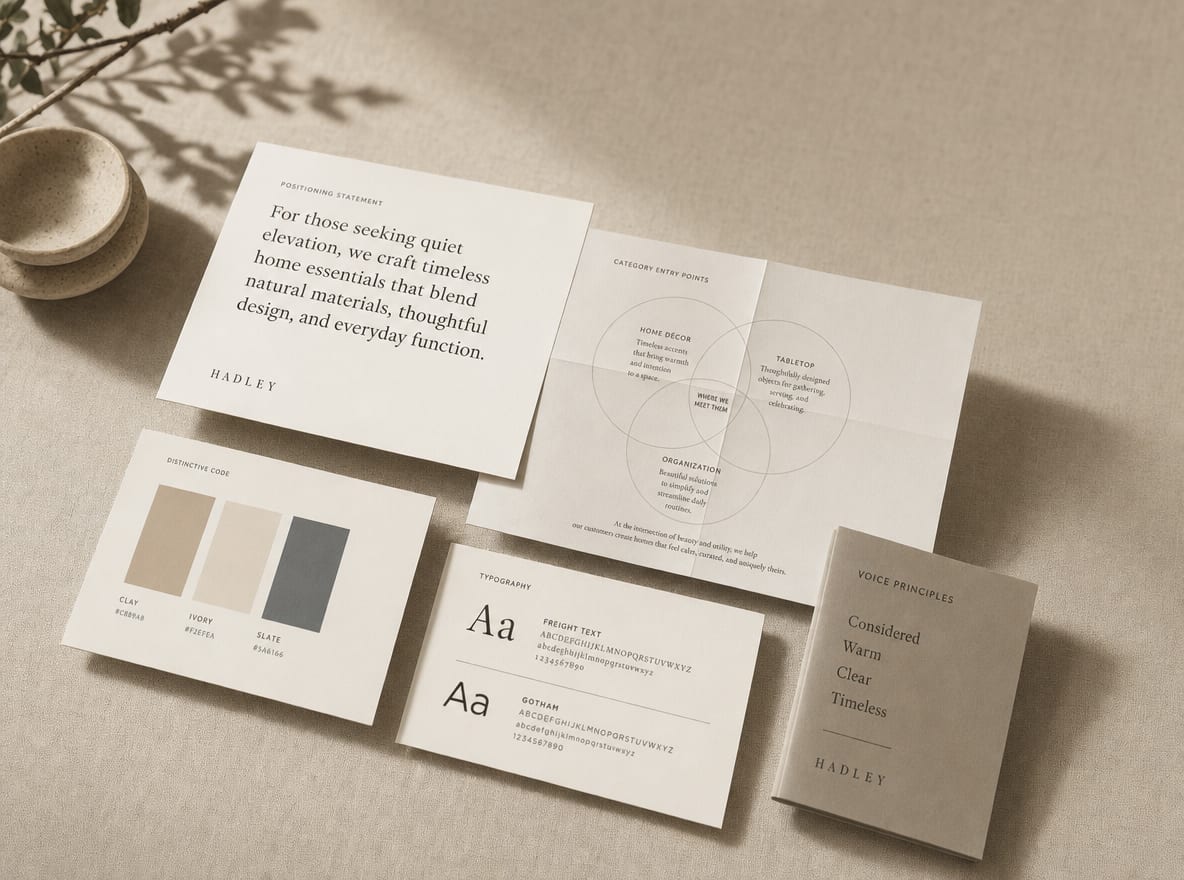
A studio still life of strategic foundation artifacts: positioning statement card, distinctive code swatches, voice principles printed flat.
Foundation

Coverage

The brand AI needs to recognise.

Brand positioning, distinctive brand codes, messaging architecture, voice and tone. Statement, narrative, competitive and whitespace map, plus the category entry points (the 7W framework researchers at Ehrenberg-Bass keep being right about). The three to five sensory assets your category recognises before the logo lands. A messaging house with value props, proof points, an elevator pitch, taglines, and a working lexicon of words to use and words to ban.

Voice principles, register by channel, sample sentences for the formats you ship most. Tight enough that a prompt holds the voice across a 200-asset rollout without drifting into the category average.

In scope

  • Positioning
  • Category entry points
  • Distinctive codes
  • Messaging house
  • Value props
  • Voice principles
  • Register by channel
  • Lexicon
  • Tagline bank
  • Competitive map
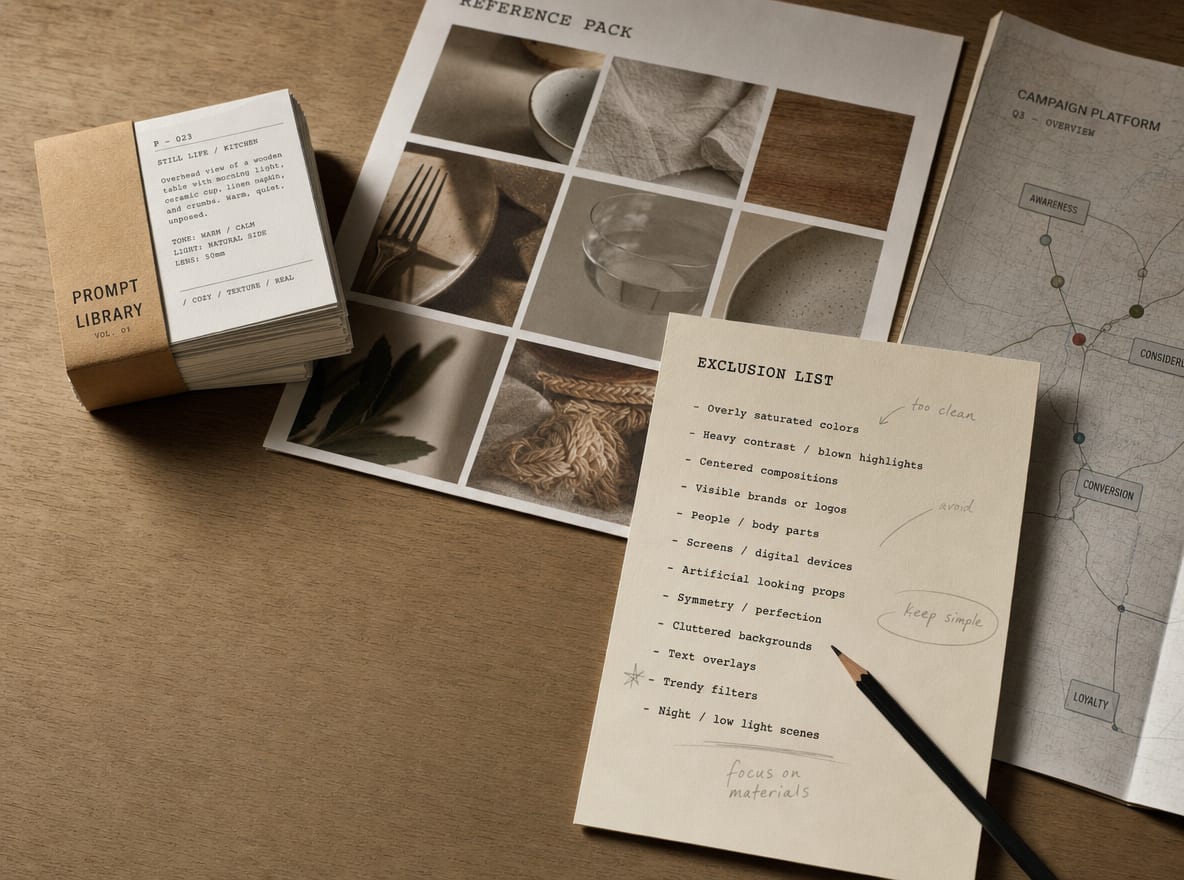
A printed prompt library, a reference pack and an exclusion list spread across a warm worktable beside a typography card.
The working layer

Coverage

Briefs, prompts and rollout, codified.

A brand expressed in instructions a model can follow, not in adjectives a human has to interpret.

Campaign platforms and big ideas. Territories, key visuals, hero concepts, storyboards, headline banks, hooks and CTAs. Three platform routes per brief, because the route that wins the room on day one usually is not the route that performs in market. Prompt systems and AI usage strategy: a documented prompt library with positives, negatives and seeds. Reference packs, exclusion lists, and a LoRA brief when a fine-tune is justified (often it is not).

Content strategy and frameworks: goals, KPIs, personas, customer journeys (including the discover-validate-buy pattern across Xiaohongshu, Douyin and WeChat for China-bound brands), content pillars, channel matrix, editorial calendar, measurement plan, governance checklist.

In scope

  • Campaign platforms
  • Big ideas
  • Storyboards
  • Headline banks
  • Prompt library
  • Reference packs
  • Exclusion lists
  • LoRA briefs
  • Content pillars
  • China journeys

Contact sheet

Selected proofs.

Strategy artifacts and platform specimens, authored in the studio. Brands are anonymised; the work is real.

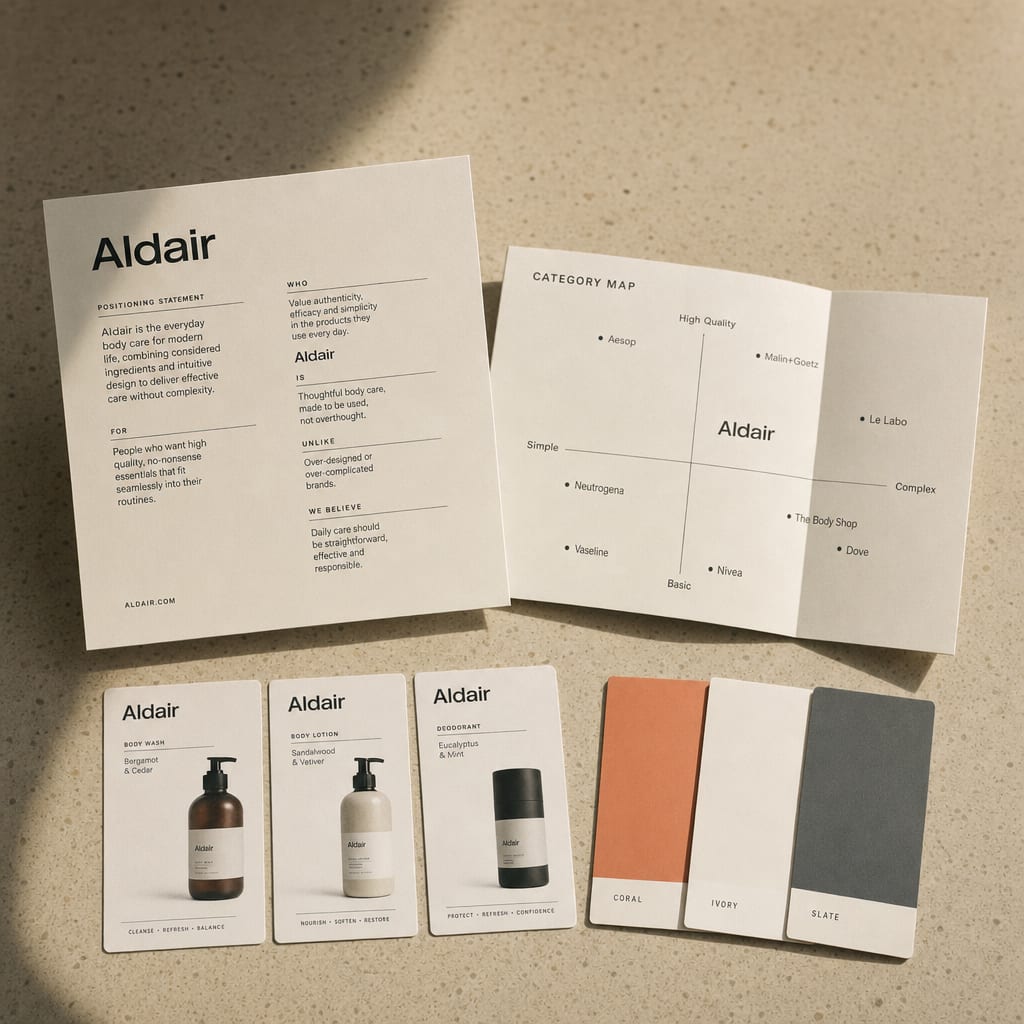
A printed Aldair positioning statement card with a category map and three colour chips, on a warm worktable.
Aldair FMCG positioning platform
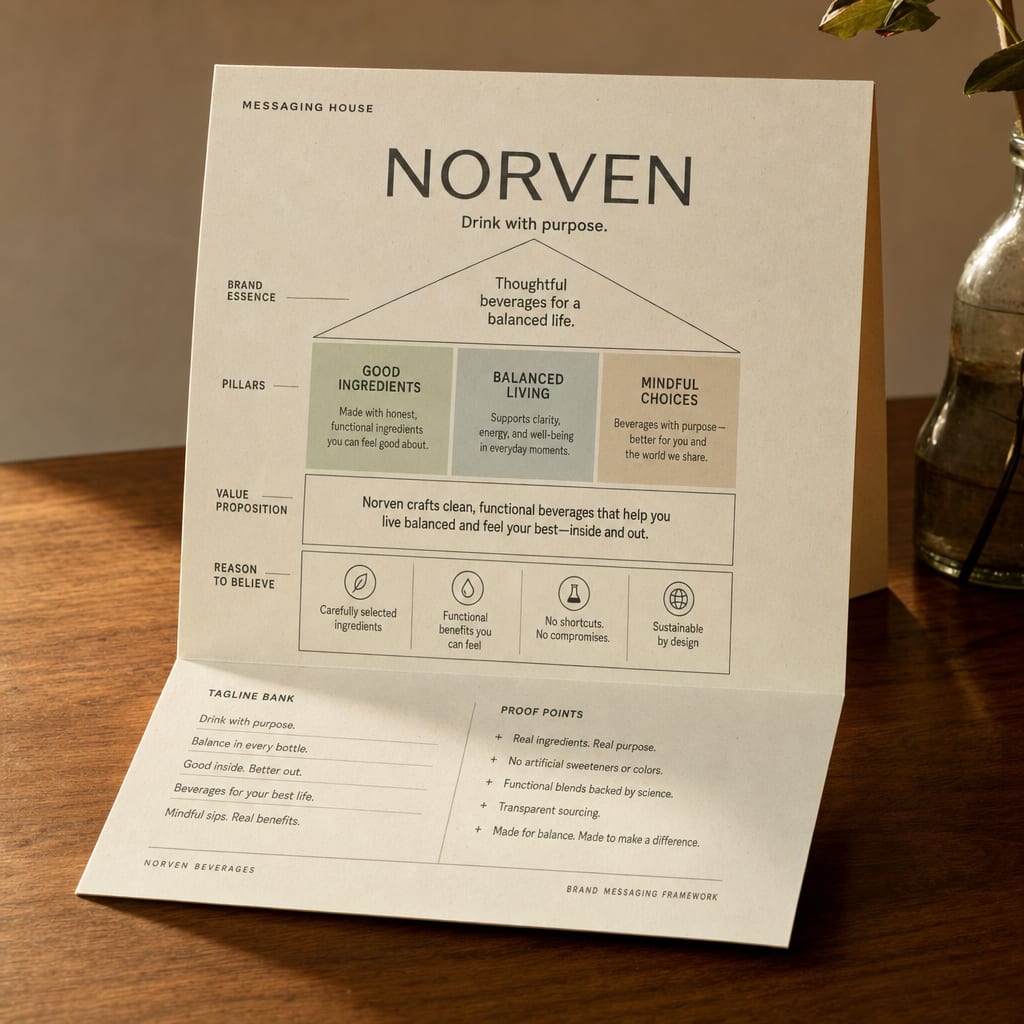
A folded Norven messaging house diagram, value props, proof points and a tagline bank, photographed flat.
Norven Beverage messaging architecture
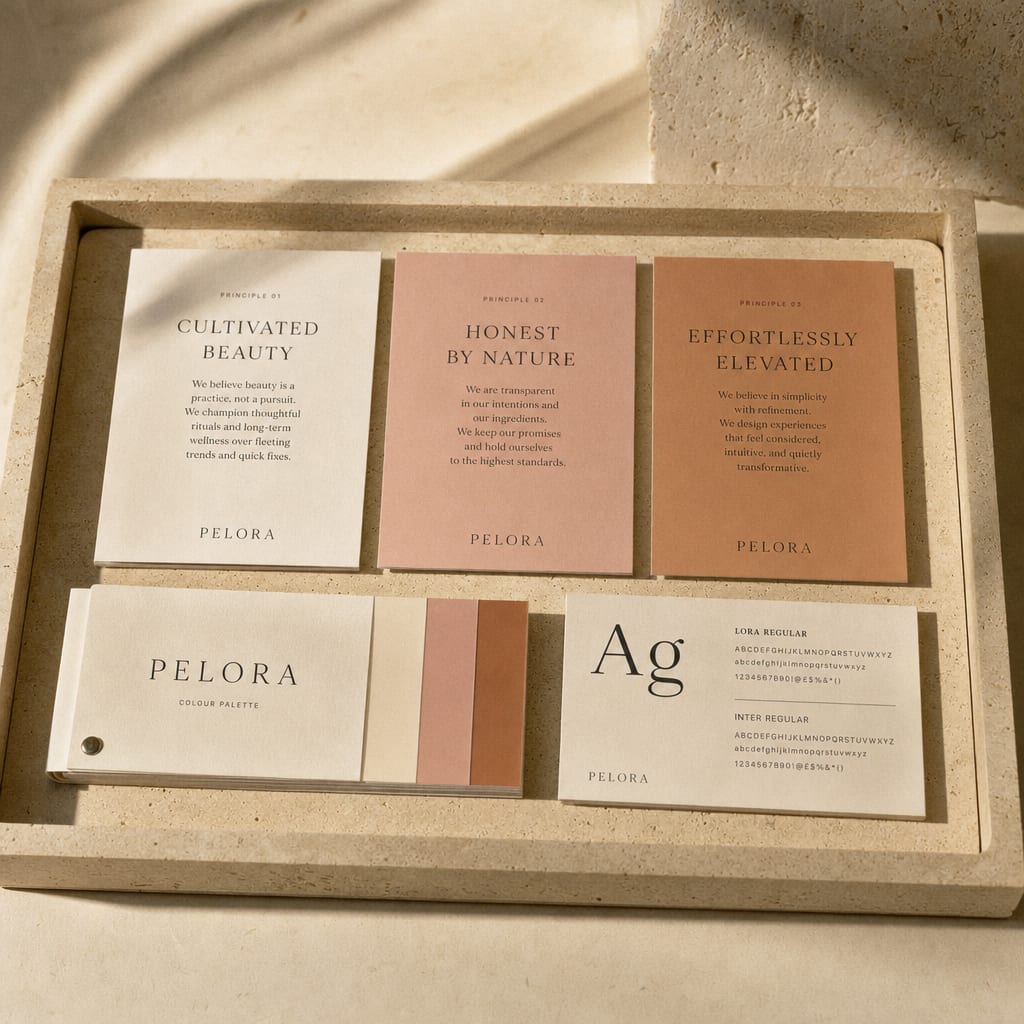
Three Pelora voice-principle cards beside printed colour swatches and a typography specimen, on a sand stoneware tray.
Pelora Beauty voice and codes
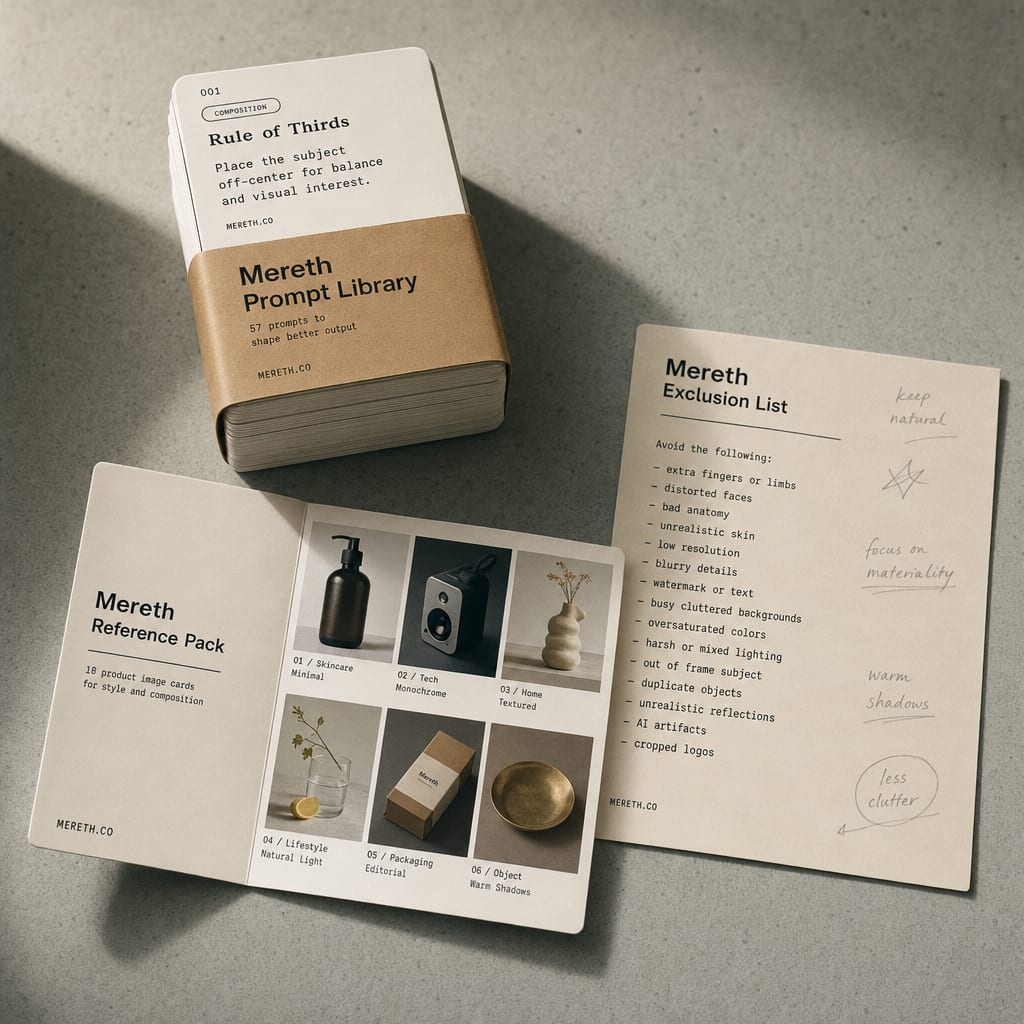
A printed Mereth prompt library card stack with a labelled reference pack and exclusion list, on a studio table.
Mereth Consumer tech prompt system
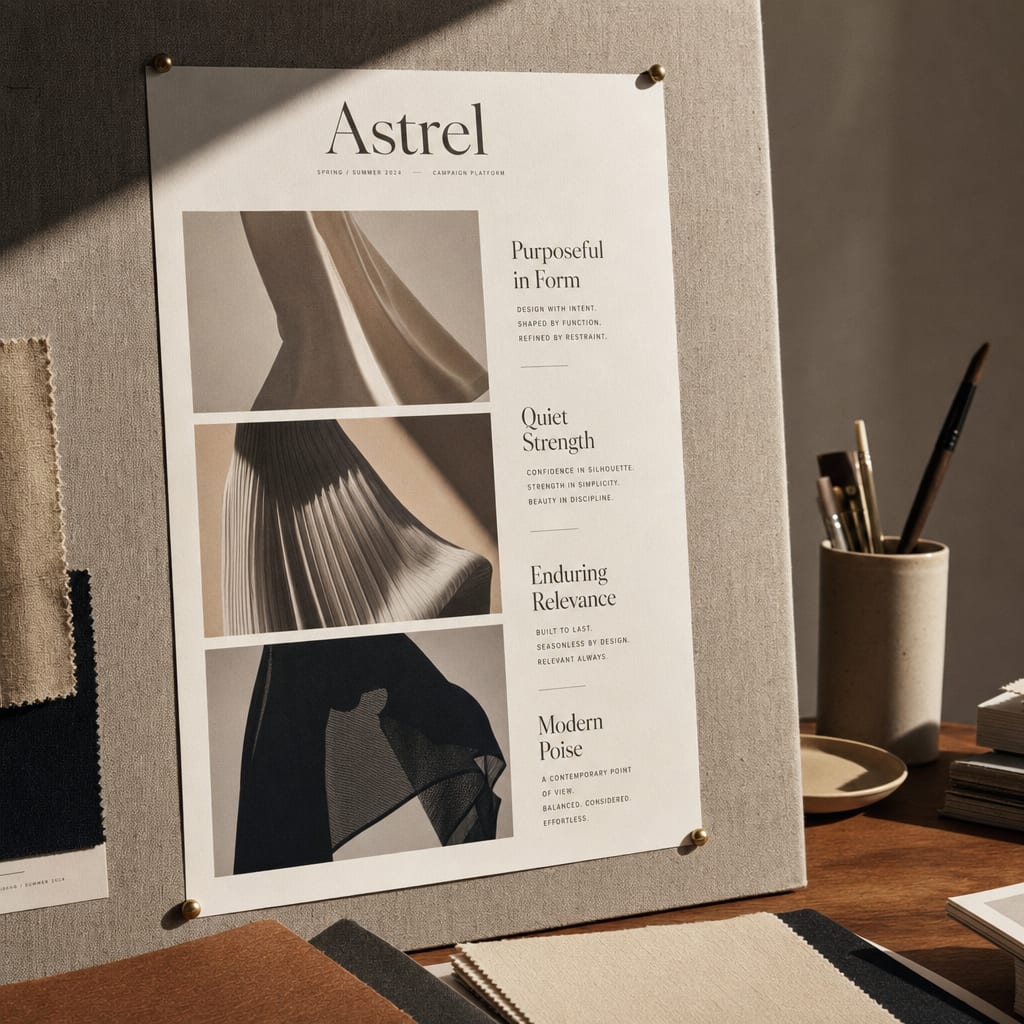
A printed Astrel campaign platform board with key visual frames and territory headlines, leaned against a plaster wall.
Astrel Fashion campaign platform
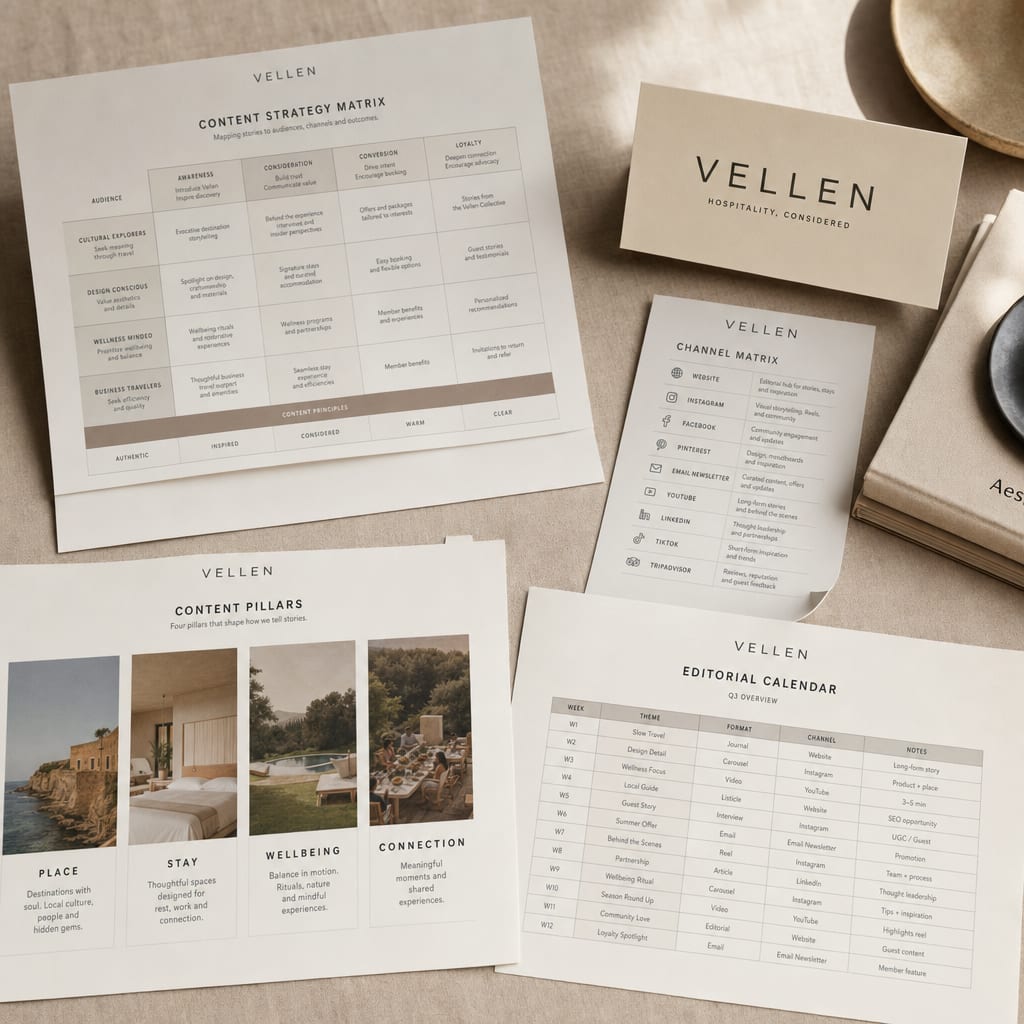
A Vellen content strategy spread on a worktable, channel matrix, content pillars and editorial calendar laid out.
Vellen Hospitality content strategy
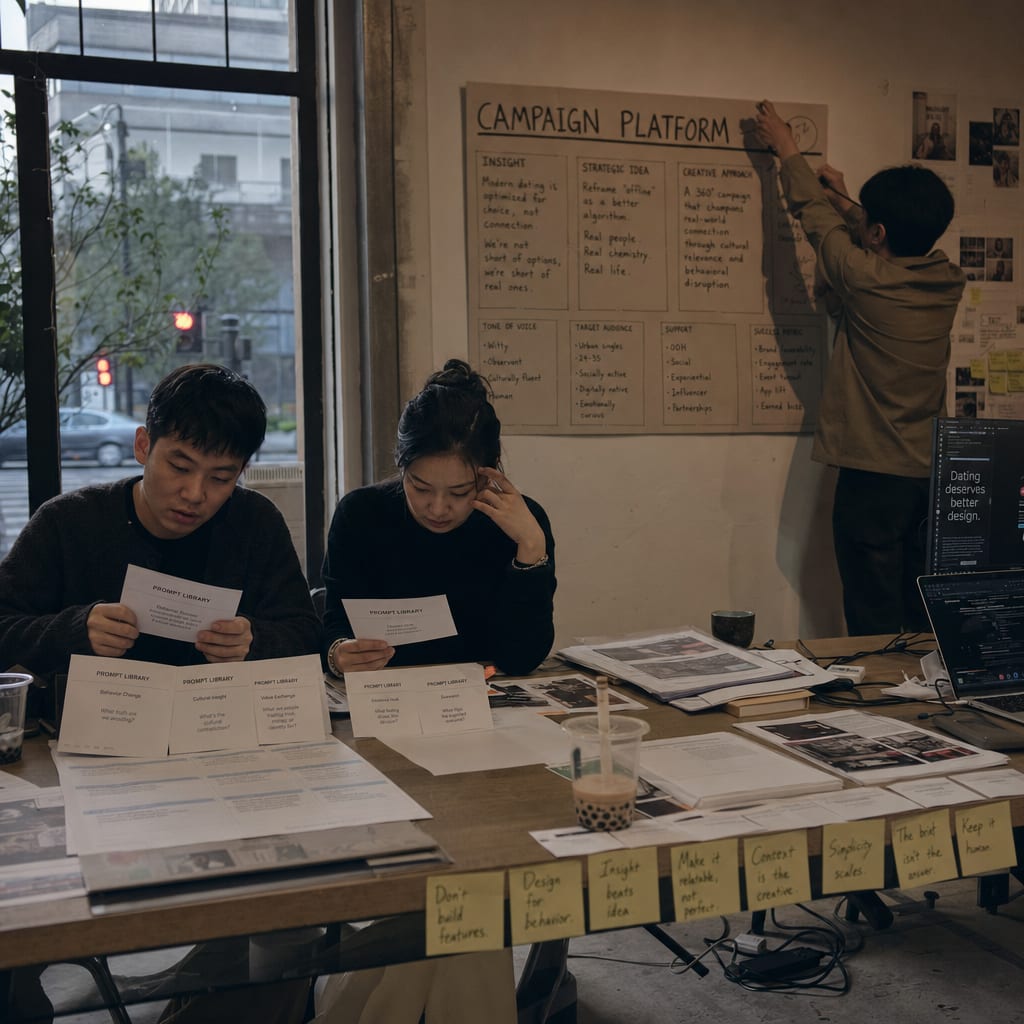
Two strategists at a long studio table working through a printed prompt library, a third pinning a campaign platform board behind them.
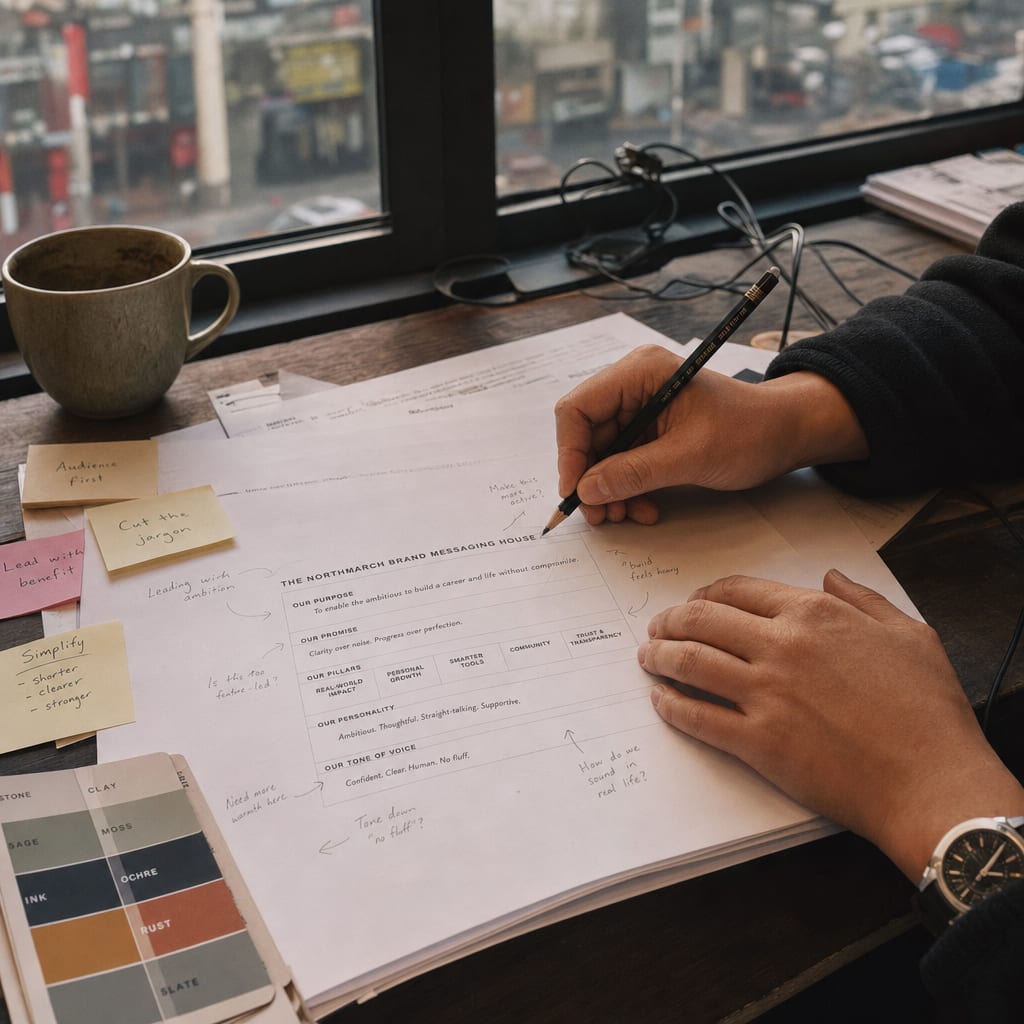
Two hands annotating a printed messaging house with a pencil, a colour chip book at the edge of the frame.
4–6 wks Brief to delivered platform

Optional capability

Need execution too?
We can produce it.

This part is optional. Most clients use the strategy work as the foundation and roll it out through their existing agency or in-house studio. The brand platform, prompt library and messaging house are built to be picked up by another team on day one.

If you would rather we run the production alongside the strategy, we do that too. Images, video, post and adaptation across markets, coordinated through one team using the same prompt systems and brand-trained models that built the platform. The advantage is consistency. The same strategist who approved the voice and codes is still on the work six months in, instead of a new freelancer trying to reverse-engineer the brand from the PDF.

  • Figma library
  • Miro boards
  • Midjourney models
  • ComfyUI rigs

We work in Miro and Figma for the strategy artifacts, with custom-trained brand models on Midjourney, Stable Diffusion and ComfyUI for visual development. Tencent Hunyuan and Alibaba Wan are in rotation for China-bound work, where the Chinese models tend to render Mandarin signage and East-Asian faces with fewer post-production fixes.

Source files, the brand platform, prompt libraries and any brand-trained models are yours either way.

Our process

Strategic direction first.
Production scale second.

AI rewards brands that already know who they are. It punishes the ones hoping technology will sort that out. So we do the unglamorous work first, then translate it into a working layer your tools can hold.

First two steps are where it is won or lost. The rest is execution.

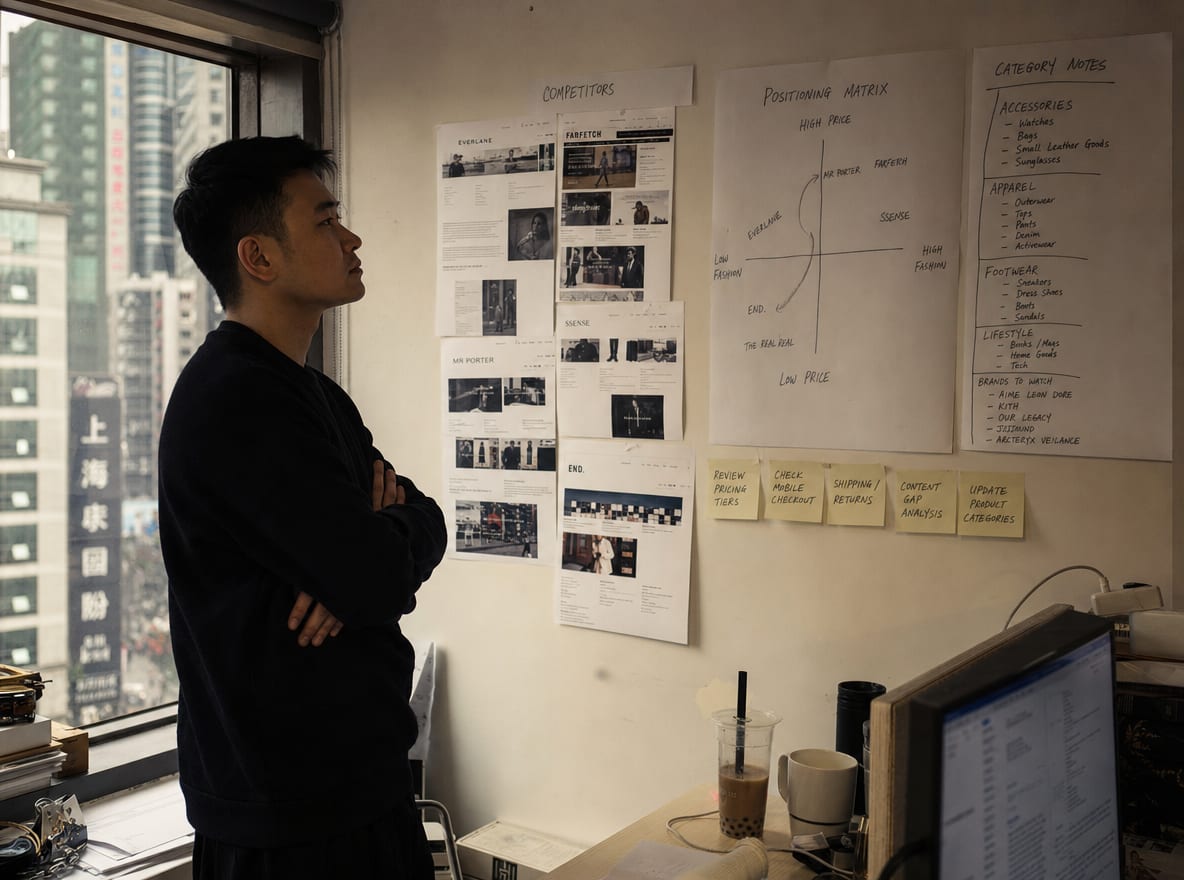
A workshop wall covered in printed competitor pages, a positioning matrix marked up in pencil and a column of category notes.
Where it is won

Discovery and audit.

Existing brand, category, audience, competitors and whitespace. Plus a clear-eyed audit of the brand guidelines, sales decks and customer voice you already have.

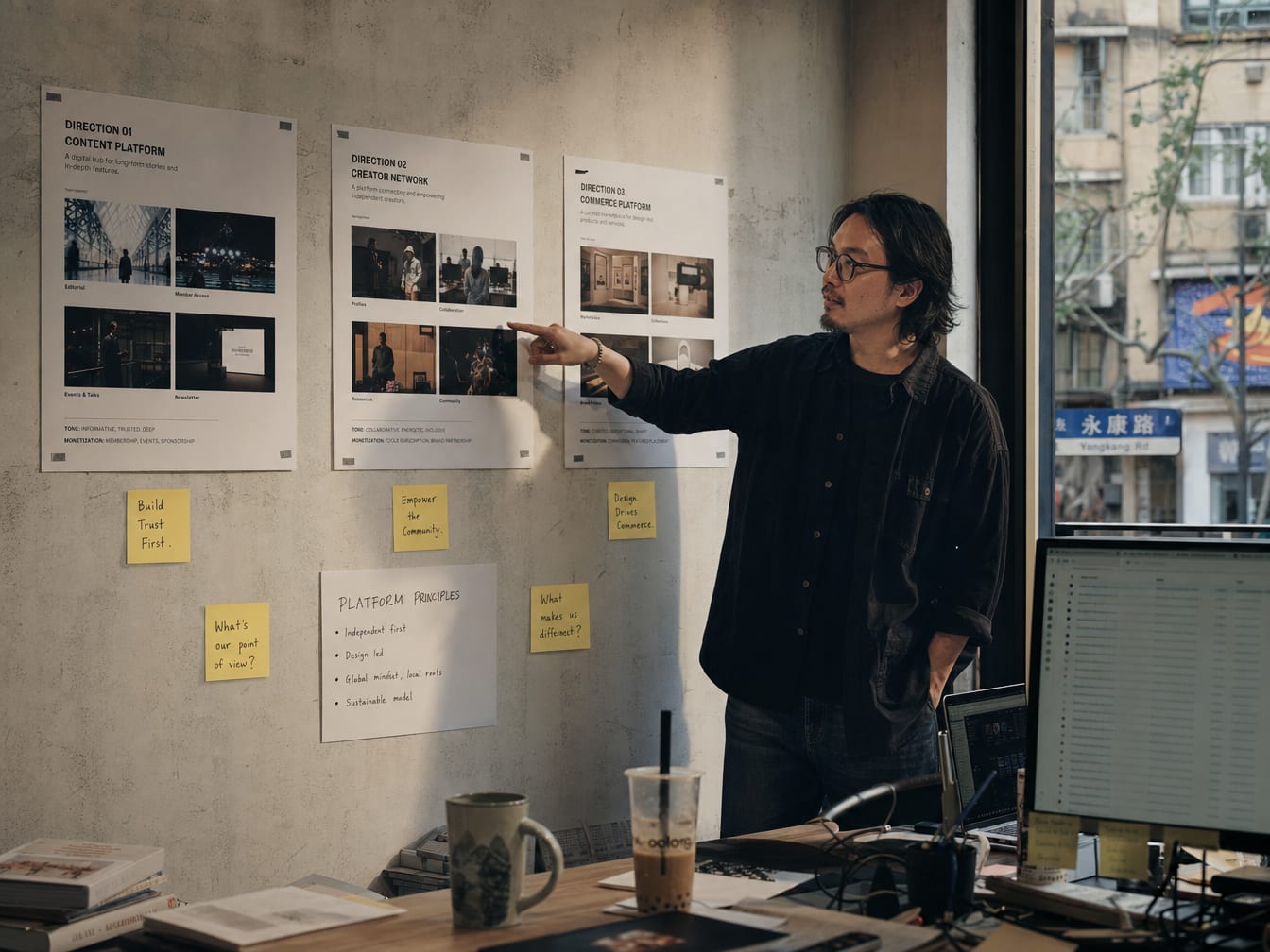
A strategist presenting three platform direction boards pinned to a plaster wall, hand pointing at one route.
Where it is won

Strategic direction. The step that matters most.

Senior strategists set two or three distinct platform routes. Each comes with positioning, distinctive codes, messaging and voice worked through enough that you are choosing between strategies, not moodboards.

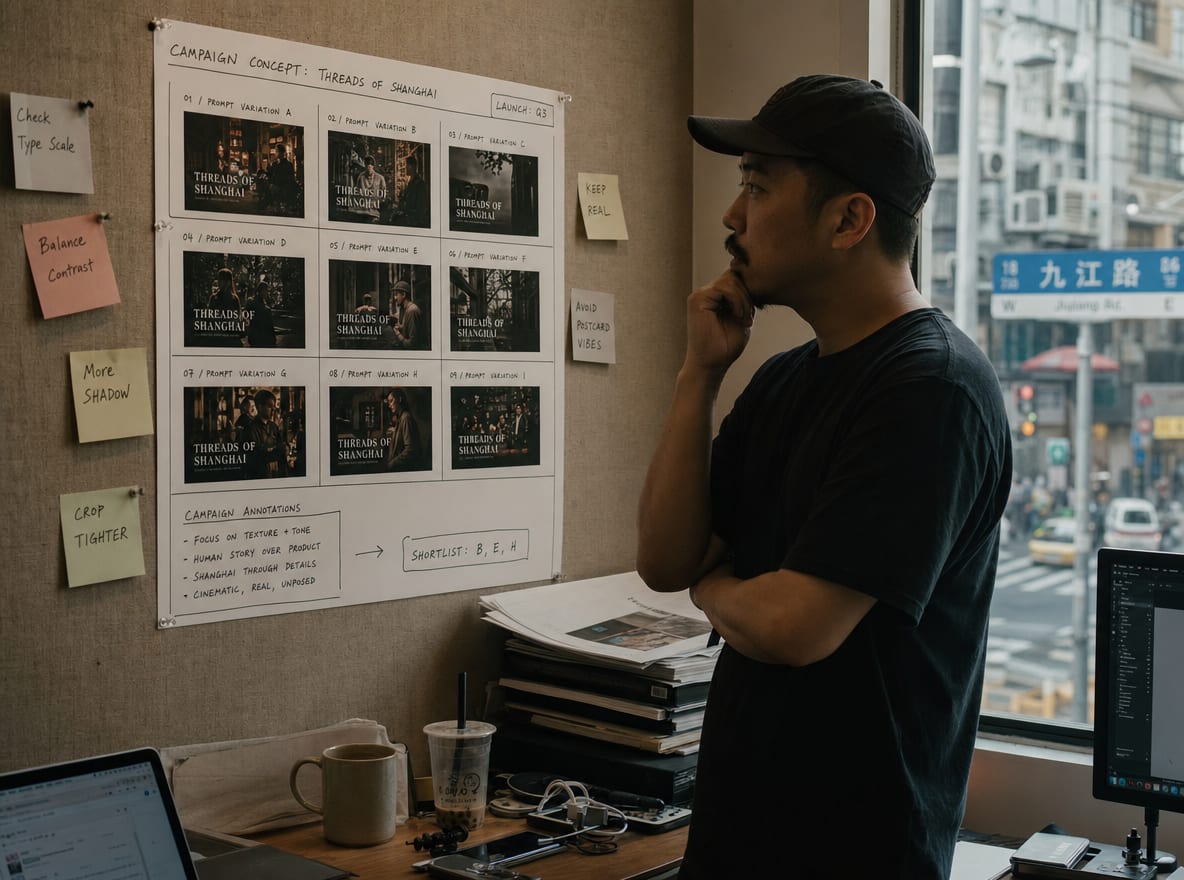
A contact-sheet grid of nine prompt variations on one campaign concept printed and pinned across a fabric board.
The rest is execution

AI exploration in context.

The chosen direction tested against real outputs: the prompt library generates campaign variants, voice samples and channel adaptations in parallel. You see how the strategy holds across a hundred assets before any of it locks.

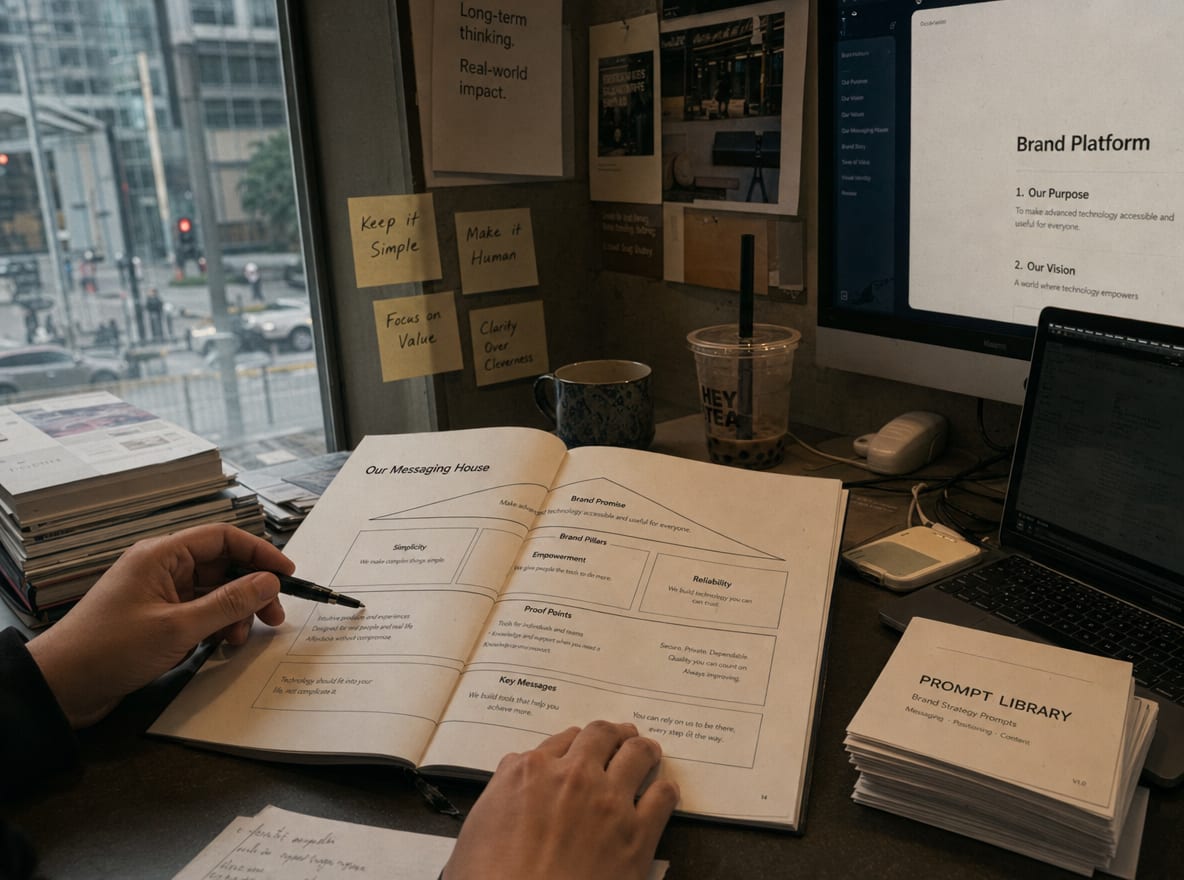
A printed brand platform book open at the messaging house spread, beside a stack of prompt library cards on a worktable.
The rest is execution

Codification and system build.

Messaging house, voice guide, distinctive codes documentation, prompt library with positives, negatives and seeds. Reference packs and exclusion lists. A LoRA brief when fine-tuning earns its keep.

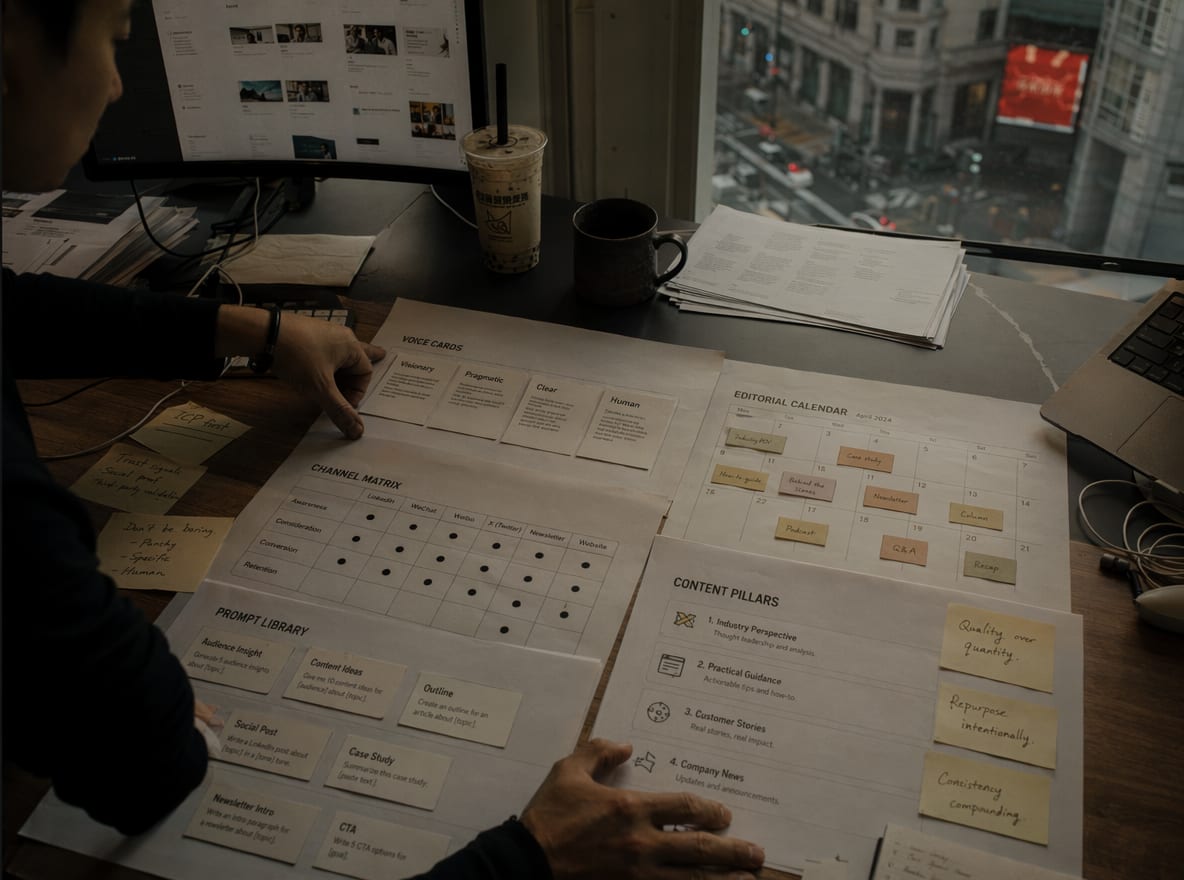
A flat-lay of strategy rollout assets: voice cards, channel matrix, editorial calendar, prompt library cards and a content pillars sheet.
The rest is execution

Rollout kit and handover.

Templates for the formats your team ships every week, content frameworks, channel matrix, governance checklist. Briefable artifacts a human team can use, and prompt structures an AI stack can hold.

The new math

How AI changes
the math.

A mid-market brand lands with a full platform brief: positioning, distinctive codes, messaging, voice, prompt library, content framework. The same scope, run two ways.

The consultancy workflow Sixteen weeks
Discovery Four weeks Direction Five weeks Codification Seven weeks

Mid-tier consultancy timeline: four weeks for discovery and audit, five for direction, then seven on codification and guidelines. Three rounds of revision, partner time billed at full rate, junior teams running the work. Heritage consultancies stretch the same scope across two quarters or more.

Our workflow Four to six weeks
Brief to delivered platform Four to six weeks

Two or three platform routes worked through enough to choose between strategies, not moodboards. The prompt library generates campaign variants in parallel so you see the strategy holding across a hundred assets before any of it locks. Codification, master files, prompt library, content framework, strategist-led the whole way.

Two weeks for a focused brief such as a positioning refresh or a single campaign platform. Four to six weeks for a full brand platform with messaging, voice, distinctive codes and a prompt library. Faster on extensions of an existing system. Heritage consultancies routinely stretch the same scope across two quarters; the compression here is real, but it comes from AI making the production fast, not from skipping the thinking.

Project-based for one-off work, monthly retainer for ongoing brand stewardship, quarterly advance billing for retainers. We quote firm after the first call once the brief and scope are clear. The number depends on market count, language count, format breadth and how much existing material we work from. We will tell you upfront and we will tell you what is driving it.

Three things. We ship strategy that survives into AI production tools, the kind of work most consultancies still do not write for. Our strategists have run accounts on agency floors, not only in slide decks, so the platform briefs production rather than winning an award for itself. And we work on weeks, not quarters. That is the timeline mid-market budgets actually allow.

Those are platforms. We are a studio. The holdco platforms work well if you are already inside the managed-service model and have the budget for it, and Canva Grow sits closer to SMB territory. We work with mid-market and enterprise marketing teams who need someone to write the strategy that goes into whichever platform they are on, or to run the platform on their behalf. We do not really care which tool you are using on the production layer.

Current brand guidelines if you have them. Recent campaign work. Three to five competitors you want to differentiate from. Sales decks or messaging your team uses today. Customer research, NPS verbatims or reviews if available. If formal brand guidelines do not exist, we work from what does and flag the gaps.

Strategists with agency planning backgrounds lead every engagement. Creative directors join for platform work. AI specialists translate the strategy into prompt systems, brand-trained models and exclusion lists. No junior teams running the brief alone.

Both. The output is built as briefable artifacts a human team can use, and as prompt structures, reference libraries, LoRA briefs and exclusion lists that AI tools can hold. You can hand the platform to Hogarth, to your in-house studio, to us, or to a competitor of ours, and the brand will still hold.

Yes. Some clients keep their brand agency for big-idea above-the-line work and bring us in for the AI production layer. We sit alongside, briefed off the same platform. We have also worked the other way around, writing the platform for the brand agency to execute.

Yes. Our team is based in Shanghai and runs daily across Xiaohongshu, Douyin and WeChat. The platform we ship for a China-bound brand accounts for the discover-validate-buy pattern (Douyin creates desire, Xiaohongshu validates, WeChat closes), the seeding model (zhong cao), KOL-KOC tiering, and the 2026 compliance climate around AI disclosure. We have watched too many Western brands translate a global platform literally and lose six months.

You own the deliverables. The platform, the messaging house, the voice guide, the distinctive codes documentation, the prompt library, the LoRA briefs. All yours. We document the workflow so your team can keep using it without us. Brand-trained models we build for you stay with you. For the full position on copyright and AI, see our Copyright and AI guide .

Try us

Try it on a
real brief.

Send us the brief. Two weeks later you get three platform directions, a written rationale, and a sample prompt library showing how the strategy would survive into AI production. No retainer, no commitment. Whatever we produce is yours.